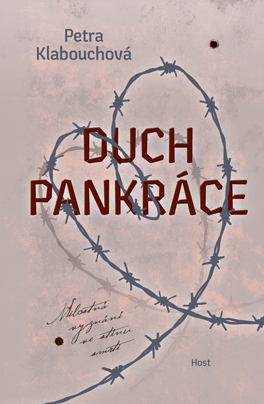
Original title: Duch Pankráce
Genre: novel
Publisher:
Host, 2025
ISBN: 978-80-275-2668-0
Pages: 350
A declaration of love in the shadow of death
In the cells of Pankrác, prisoners listen to the pounding of workmen’s tools beyond their windows: a guillotine is under construction. Anna and Robert, both condemned to death, have never met. All that connects them are a few fleeting glances and an endless desire for love. For this, they need but a scrap of paper and a pencil. In the oppressive atmosphere of the prison, by secret notes, they pass on fragments of themselves – memories, hopes, tenderness. Though they know that time is running out, words ignite between them, like flames in darkness. The story is complemented by unsung heroes, notably a warder who delivers messages and a family living beside the crematory in the Prague district of Strašnice who hide the ashes of the executed.
This novel is based on real-life memoirs written on death row. The author brings forgotten voices to life with a deep empathy, showing that love is possible even at moments of utmost difficulty. The book includes this afterword by the author.
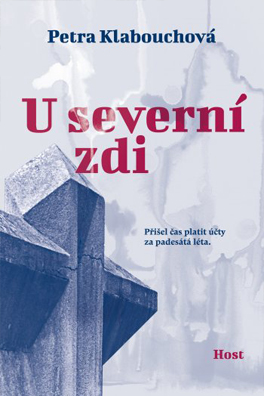
‘I consider this book a prequel to the novel By the North Wall,’ says the author. ‘The connection is made not by the characters but by fateful happenings in a single place, the Pankrác axe-room. They remained in my thoughts along with other stories that didn’t fit in the previous book. I decided to return to these stories and tell them. Many hundreds of secret notes written within minutes of death express the wish that we should never forget. Last wishes must be honoured.’
"Petra Klabouchová is currently one of the bestselling Czech authors, and deservedly so, thanks to her compelling combination of historical events and stories full of human drama.
(…) Klabouchová follows the trail of Nazi tyranny in stories inspired by real-life messages smuggled from the death cells at the Pankrác execution bloc known as the axe house. Focusing on the fates of several characters, both victims and murderers, she shows how ruthless the deadly machinery was. And she goes looking for sparks of humanity, love and hope in that inhospitable place."
Irena Hejdová, Deník N
"This political thriller captures the atmosphere of Pankrác prison during the Nazi occupation, as its inmates await death but seek ways not to die before their execution. People remember, fight, despair, hate, sometimes even love. They are still people. And Petra Klabouchová allows them to retain their humanity within our historical memory, more than eighty years after their death.
The Spirit of Pankrác does not offer experiential history, but a brutal story built on extreme emotions. It narrates one of the most bitter experiences of modern Czech history in contemporary language, while remaining faithful to historical sources.
(…)
The author has brilliantly mastered the challenging art of transforming dramatic reality into a vibrant literary reflection. She is not content to stay within the bounds of the historical novel, even though many of her characters have real-life counterparts. Instead, she does not hesitate to populate her world with fictional or archetypal characters, using them to capture the underlying currents of the times.
In the author’s hands, dusty facts come alive to create a magnificent concert. She is not afraid to flesh out dialogues and motivations, building her story upon them rather than relying solely on dry archival records. This is precisely why her characters feel so authentic; their behaviour rings true, regardless of whether it is backed by historical sources.
Petra Klabouchová’s name has come to be a byword for masterfully handled suspense in Czech literature. The horrors she describes are never there for their own sake. They endeavour to break through the surface of forgetfulness and glib, contextless answers. The author depicts evil in order to be able to name it. Her revelations are so uncompromising that the reader cannot help but take a stand. This is not just reading – it is an experience.
As The Spirit of Pankrác testifies, it would be shortsighted to see Klabouchová solely as a creator of suspense. She is much more a chronicler of emotion, proving just as adept at capturing the inner workings of the mind on the positive side of the spectrum.
The tagline “confessions of love in the shadow of death” is not only the subtitle of her latest book, but also a reminder that hope and love are an entirely natural part of her repertoire. Of course, this is no easy hope, nor is it fulfilled love; yet the tendency to pit the humane against the inhuman is a constant presence throughout the novel.
(…)
Klabouchová is a grandmaster of the short, stark sentence. Stripped to the bone, her prose mirrors the failing breath of her protagonists and evokes the short stories of Isaac Babel – which are themselves no strangers to bloodshed. Ultimately, this style serves to heighten the suspense even further.
(…)
Klabouchová wades through blood so that the readers don’t have to. And she lets them experience a glimpse of love and compassion so that they may long to be of the same kind even in difficult times."
Aleš Palán, Právo, Salon
"There is no respite from this captivatingly rendered pain and despair, but that is precisely what the author’s vast following loves: on the Databáze knih platform, some seven hundred reviewers have given The Spirit of Pankrác a combined rating of 96%."
Kateřina Kadlecová, Reflex