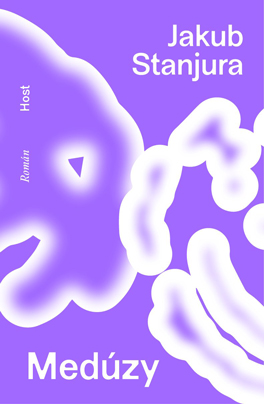
Original title: Medúzy
Genre: novel
Publisher:
Host, 2025
ISBN: 978-80-275-2661-1
Pages: 250
Rights sold to:
Germany (Anthea)
A penetrating psychological novel about the end of friendship, guilt and chronic pain
Having arrived at her best friend’s apartment to discover a pool of blood on the floor, the novel’s narrator does something unexpected. Rather than reporting the gruesome discovery and looking for her friend, she prepares a statement for others who should investigate the mysterious disappearance.
At the same time, she feels the pain in her stomach that doctors have long been unable to explain. This time, it is stronger and accompanied by a strange burning and throbbing, prompting questions of what connects the two women perhaps more than they would wish.
Jakub Stanjura’s second novel tells of the most extreme social taboos. Medusas do more than just provoke. Like the water in which medusas thrive, it reveals all sorts of things: some beautiful and fascinating; others repulsive, monstrous and unspeakable – and not at all easy to face.
‘For me, medusas embody misunderstanding ,’ says the author. ‘We perceive them as creatures that do harm. Yet we are forever harming them by threatening their safety and violating their home. The actual danger is often not understood.’
"This book deals with numerous topics, such as toxic friendships, chronic illness, body shaming, and a dysfunctional healthcare system. In addition to being a psychological novel, it is also something of a detective story. Jakub Stanjura covers all of this in a book that literally stung, hurt and clung to me like actual jellyfish. It’s been an awful long time since I last felt a book in my very bones, devoured every page, and had absolutely no idea how the story would end. And what’s more, the book is brilliantly and engagingly written. I think it’s good that contemporary Czech authors are not afraid to broach taboo subjects."
Klára Nováková, Radio Wave
"In addition to chronic pain, the book also deals with structural inequality, precarious work, youth poverty and the psychological problems involved. The pain simmers beneath the surface and gradually transforms like some strange creature from stabbing to cutting, then burning and searing, until it is absolutely unbearable. It is the torment of particular digestive organs, but it also gathers within itself all other levels and forms of pain: female invisibility, economic vulnerability, emotional neglect, environmental anxiety and the degradation of public space. As if the main character had no choice but to be invisible and translucent like underwater animals.
(…) A prose work arrives at the bookstore that could even make the reader feel physically unwell, but perhaps there is ultimately something healing in it for all that."
Nikola Benčová, Právo (Salon)
"Medusas is the first Czech novel in which a sick digestive system turns into the chief protagonist. The intestines give rise to the notional deus ex machina of a story in which the boundaries between friendship and rivalry are broken and where inner pain quickly grows into brutality and external aggression. A psychological thriller, body horror and detective story all in one. It was an irritable colon that did it.
(…)
In this seemingly irrelevant detective story, it’s not about who the murderer is. Nor is it about who the victim is.
“What if Medusa enjoyed her anger?” asks the narrator, alluding to the ancient myth of a woman transformed into a monster by suffering. She herself searches for the one she turned into after the illness, as the pain turned into aggression. And had it not settled down there long before, somewhere deep within her body?
Stanjura’s literary quest extends from Greek myths to the seabed, where inconspicuous, transparent giant jellyfish defend themselves from danger with a burning sting. In Medusas, it is a wounded, trapped creature that wields the sting. Who knows where it is hiding within us? And when is it going to want to break through to the surface...?"
Jonáš Zbořil, Seznam Zprávy
"A psychological probe into a female friendship, a thriller, a detective story, or a description of a mysterious illness that is not talked about because it manifests as extreme diarrhoea? Jakub Stanjura has covered all of the above in Medusas.
(…)
Again in [the author’s] second novel, it is clear from the first pages that what people don’t say and what they mask is more important than what they do say. The devil is in the details."
Alena Němečková, Vlasta
" “We usually perceive friendships as healing. But many of us also know someone whose friendship we would rather put an end to,” says writer Jakub Stanjura. In his latest novel Medusas, as in his previous novel Augusts, he deals with manipulation in relationships and coping with a chronic illness.
(…)
This time too, [the author] writes from the standpoint of the female protagonist, exploring a relationship that is gradually becoming more and more toxic.
But at the same time, he subjects the narrator to mysterious abdominal pains. He was inspired by his own experiences, having begun to struggle with similar symptoms while working on the book. “Naming the things I was experiencing with my body was difficult for me, but also cathartic,” the writer admits.
The novel Medusas begins as a chilling crime story: the chief protagonist enters her friend Monika’s apartment and sees pools of blood on the floor, but cannot find the latter among the disarray.
Instead of calling the police, she slams the door behind her and quietly walks out. The nameless narrator immediately appears suspect. If she were completely innocent, she wouldn’t have let someone close to her disappear just like that.
But in his latest prose work (...), Jakub Stanjura plays out another – no less thrilling – detective story.
While the investigators are searching for Monika, the narrator tries to uncover the origins of her own health issues. She suffers from excruciating abdominal pains, and due to digestive problems, she has to radically curtail her diet. Whenever she leaves home, she has to carefully check whether there are any toilets to hand.
Meanwhile the doctors are at a loss, or even trivialize the protagonist’s problems. They recommend a strict diet, attribute the persistent cramps in her stomach and intestines to being overweight, and even tell her that she should have lost weight a long time ago.
The thirty-year-old author describes the sudden onset of the digestive problems and the hopelessness, alienation, and indignity of the medical examinations so vividly that it is impossible not to sympathize with the narrator."
Tomáš Maca, Deník N
"Extraordinary style and choice of themes. Jakub Stanjura’s books are books of the times we live in."
Martin Fryč, cultural promoter and lecturer, Deník N’s Book of the Year Poll