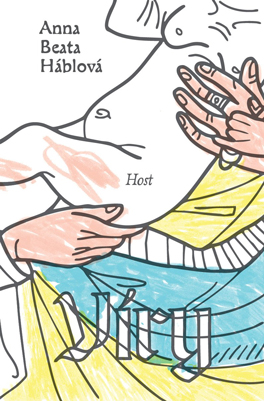
Original title: Víry
Genre: novel
Publisher:
Host, 2025
ISBN: 978-80-275-2384-9
Pages: 270
Rights sold to:
Italy (Bonfirraro Editore)
Where might our beliefs lead us?
Ester is a divorcée who supports herself and her son. These circumstances would be ordinary but for the fact that she makes her living as a prostitute, a detail she keeps hidden from those around her, as she does the string of events that pushed her into this trap. Ester and her son live in the Uplands, in the house of her grandmother, whom she remembers for her kindness but also for her beliefs, the restrictive nature of which bordered on bigotry. To make her stressful living, Ester commutes to Hatě, on the border with Austria, a bizarre world of casinos, brothels, markets and other attractions, where she offers herself under the crude supervision of the pimp Mára.
It is here that another unexpected incident occurs – one that will change the course of Ester’s life for good and all. In the vortex of manipulation, violence and bad decisions, does it represent a step for the better or the worse? She has but one good reason to persist with her battle for survival, in the person of her eleven-year-old son Vojta. But what if he were to find out the truth about her? Subjects addressed in this new novel by the multi-talented successful writer/artist include beliefs we cling to withstand the turbulence of fate and our transformation by light on the threshold of death.
"The self- confident pace of the prose is pleasingly complemented by subtle atmospheres and fine details and emotions – in short, by the poetry to which Háblová’s roots as a writer predispose her. Most importantly, the author is able to examine topics of great social urgency from an impressive, intimate perspective, without any kind of moralizing..."
— Martin Stöhr, editor
‘An examination of the life of a sex worker who is in the business despite her strict Catholic upbringing, the story asks whether faith is merely a crutch of some kind or a space or link where the physical and spiritual worlds come together ,’ says the author. ‘It also begs the question of whether excessive striving to follow rules can lead to an absence of understanding and compassion: it is easy to take offence at someone, hard to be the one who causes the offence…’
Selected for New Czech Books 2025, the catalogue published by the Czech Literary Centre
"Czech literature has produced plenty of new releases this year, and we consider Anna Beata Háblová’s novel Beliefs to be one of the most interesting recent arrivals. Released only at the beginning of November, it is a compelling and touching read in that subtle way that gets under your skin.
(…)
We learn about the clients’ horrific stories, the humiliating past of Ester’s marriage to Marcel, and her childhood with a pious grandmother and a bad-tempered mother. Ester’s misery in life intensifies when, in her desire for happiness, peace and money, she falls victim to scammers, and the reader, who cannot help but keep fingers crossed, is just terrified of what cruel things are going to happen in this drastically realistic story, like a social film by the Dardenne brothers.
At the end of the second third, there’s a grotesque twist, transforming Ester from a prostitute into a climate activist, raising the surprising hope that you can even dig yourself out from under rock bottom.
A perfectly balanced novel that tells the story of a desire for good and resistance to an all-consuming evil from which there is almost no escape. But thanks to the hopeful ending, it also offers the certainty that everything can turn out for the better."
Irena Hejdová, Deník N
"Such an insufferable heroine, and yet you want to keep reading. The second novel by architect, artist, and writer Anna Beata Háblová, with the ambiguous title Víry (Beliefs, but also Whirls), is a remarkable parable about gaining control over your own life.
(…)
The author is not trying to shock you with dramatic images of a Dickensian fallen woman of the night, but she is pursuing other goals. She remains faithful to her poetic language – it comes as no surprise that she was named Poet of Prague 2026. In this text, she very plausibly blends linguistic levels, from the lyrical to the colloquial and the vulgar.
(…)
Philosopher Alice Koubová has written about the feminist line of Beliefs in the magazine Tvar. 'It really doesn’t matter, women, where the humiliation takes root. There is only one thing that is important. The way out does not lead backwards, but forwards against fear. You have to admit that things aren’t going to get pretty with people. The more you retreat, the more terrible the confrontation will be, but if you don’t want to be killed by a pedophile, drink yourself to death, scurry along whenever he commands, withdraw a statement when the phone rings, or be ridiculed in academia, you will have to mature beyond fear,' she stated.
It may sound too harsh, some might see it as shifting responsibility onto the victim, but that’s what’s most important here – to stop being a victim. There’s no point in promising to be “good” without any subsequent effort on your part, but then nor does it mean you have to turn into a superhero and that it’s all down to you.
Swallow your pride, be honest with yourself and your loved ones, and don’t let fear paralyze you – that could be the first commandment of Ester’s new Ten Commandments. And not only that. Anna Beata Háblová, with her novel parable, tries to show the way to every woman, to everyone who feels humiliated and doesn’t know how to move forward."
Kateřina Čopjaková, Seznam zprávy
"Maybe it’s about the whirlpools in the water that eleven-year-old Vojta explores.
Maybe it’s about the beliefs both believed and not believed by his mother Ester, a prostitute who drives to Hatě from a cottage left by her grandmother, which she doesn’t want to lose in foreclosure.
Maybe it’s about self-worth and self-respect, maybe it’s about what’s at the bottom and how deep it goes.
Maybe it’s about cooking plum dumplings, how all slimy they are fished out of the pot with a colander, and about the congealing grease on the cooling soup.
Maybe about climate activism, Russian disinformers and life after death.
Maybe it’s about generational trauma, the female lineage, and how hard it is to clean it up.
Maybe those poems between chapters have some meaning and aren’t just space-fillers.
But above all, it is a text somewhere between narrative and the grotesque, about gaps, about non-places (after all, Hatě could easily be in Anna’s Non-places in Cities / Nemísta měst, belonging to no one and everyone, like Ester’s body), about pain and pleasure and the boundary between love and hurt, about the motives that decide whether it will be love or pain. About how thin the divide is between good and evil, God and hell, sin and redemption.
Add time and space, and it looks low-key at first, but then it builds up till you devour the second half like some hyped-up action-movie trailer – like a successful slam, it has rhythm and oomph.
If there’s one must-read out of what we’ve published recently, it’s this unassuming little novella.
I was dragging it around in my backpack all day, wondering where it was going, and yesterday I finished the second half in one go, while bawling and happily waving the book around, like, yeah, this is what a text should look like when the author knows where they want you, and it all clicks!"
Klára Kubíčková, journalist, FB